The Two Traps of AI Thinking
19 October 2026
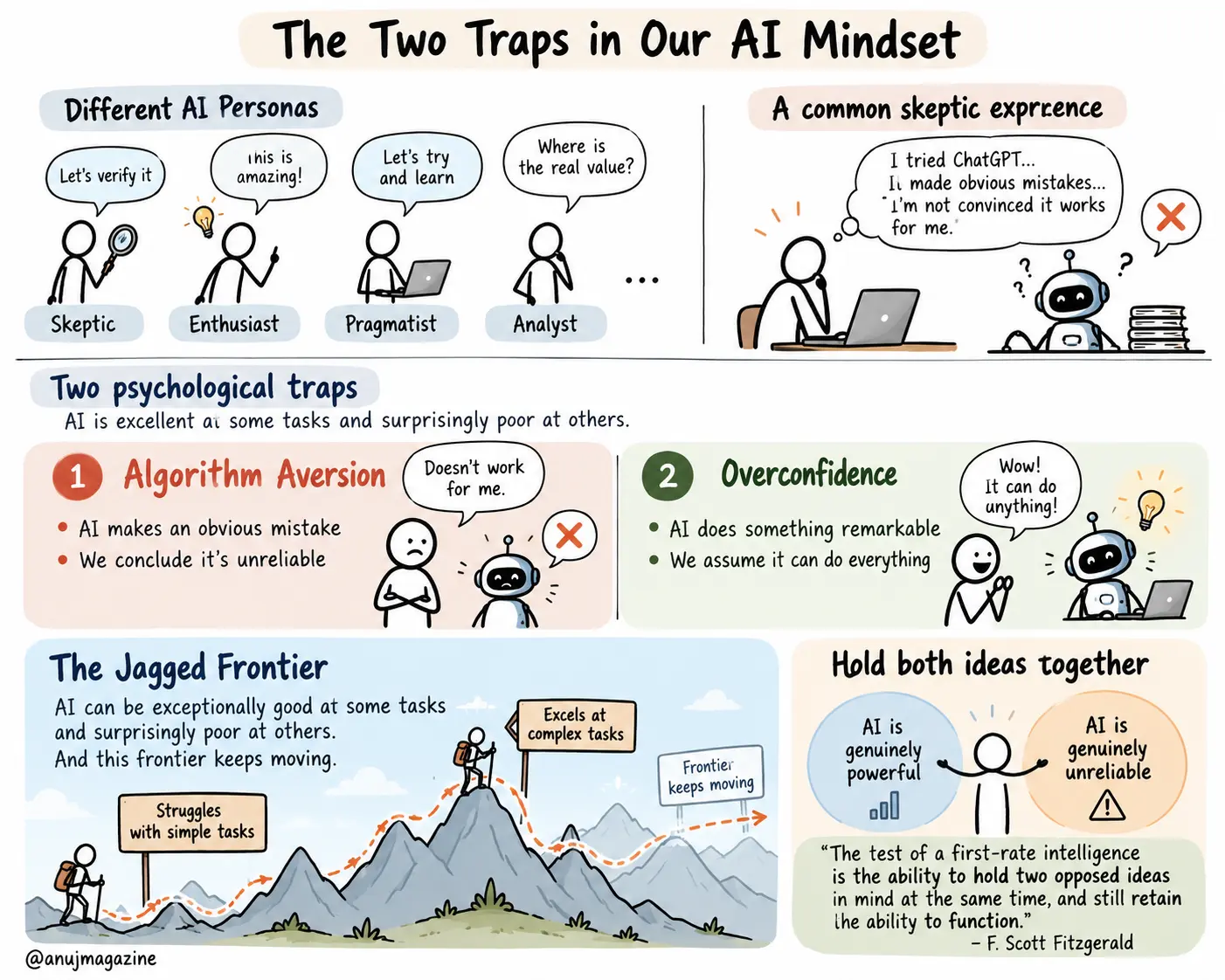
In most of our AI engagements, we come across different AI personas. Each brings a unique perspective. I find well-read skeptics particularly valuable at this stage of AI’s evolution.
However, conversations with skeptics often go something like this:
“I tried ChatGPT (or any AI), asked it a few questions in an area I knew well, and caught it making some rather obvious mistakes. I really wonder if all this AI hype is justified. I’ve concluded that AI doesn’t work for me.”
I recently started reading Ethan Mollick’s new book Co-Existence, and it offers a useful perspective on this situation. He describes two psychological traps that prevent us from using AI effectively, particularly because AI is excellent at some tasks and surprisingly poor at others.
One is Algorithm Aversion, and the other is Overconfidence.
-
Algorithm Aversion: We see AI make an obvious mistake and conclude that the technology is unreliable. One bad experience can shape our opinion for a long time, even as AI capabilities continue to improve.
-
Overconfidence: The opposite problem. We see AI do something remarkable and assume it can do almost everything. Its impressive capabilities make us overlook its limitations.
Both are problematic.
AI has what researchers call a jagged frontier. It can be exceptionally good at a complex task and surprisingly poor at something seemingly simple. And that frontier is constantly shifting.
Perhaps one of the most important aspects of AI literacy is learning to hold both these ideas together.
This reminds me of a popular quote:
“The test of a first-rate intelligence is the ability to hold two opposed ideas in mind at the same time, and still retain the ability to function.”